
Browse Policy Briefs:
-
Drone Delivery of Bioweapons: Responsibilities for Force Readiness
James Giordano and Diane DiEuliis
This Strategic Forum by Dr. James Giordano and Dr. Diane DiEuliis explores the convergence of drone technology and emerging biotechnologies. This includes synthetic biology, gene editing, and nanoscale biomaterials, and their implications for military readiness and national security. It examines how these dual-use technologies could enable novel delivery methods for biological agents, expanding the threat landscape and lowering technical barriers. The analysis emphasizes the need for proactive defense planning, enhanced detection and countermeasures, and integrated strategies to mitigate risks, ensuring force readiness in the face of evolving biological threats.
-
Responsive Space and Strategic Information
Simon P. Worden and Randall R. Correll
“Responsive Space and Strategic Information” argues that the U.S. relies too heavily on large, costly satellites that are difficult to adapt in a crisis. This paper proposes a more flexible approach: responsive space. This means launching small, low-cost payloads on short notice to replace, reinforce, or add new capabilities when needed. Responsive space can also support information operations, shaping how adversaries perceive events and make decisions. By linking space capabilities with strategic information, the United States can improve deterrence and act faster in competition and conflict. In the future, speed, flexibility, and adaptability may matter more than size or permanence.
-
China’s Forever War: What If a Taiwan Invasion Fails?
Joel Wuthnow
This Strategic Forum by Dr. Joel Wuthnow, in the INSS Center for the Study of Chinese Military Affairs, examines the strategic consequences of a failed People’s Republic of China (PRC) attempt to invade Taiwan. Rather than assuming defeat would restore deterrence or compel Beijing to abandon its objectives, the article argues that a failed invasion could lock China into a prolonged, coercive conflict—a “forever war”—marked by sustained military pressure, economic coercion, gray-zone operations, and heightened escalation risks. Drawing on Chinese strategic culture, leadership risk tolerance, and civil-military dynamics, the analysis explores how Beijing might adapt politically and militarily following failure, including shifts in force posture, mobilization, and domestic control. The article also assesses implications for U.S. and allied deterrence strategies, emphasizing the need to prepare not only to defeat an invasion but to manage the long-term security environment that would follow. Ultimately, the piece highlights that preventing conflict requires credible deterrence across all phases of competition.
-
Rightsizing Chinese Military Lessons from Ukraine
Joel Wuthnow
Russia’s failures in the early phases of the 2022 Ukraine conflict, and Ukraine’s successes, have raised questions about the implications for China’s People’s Liberation Army (PLA). U.S. and other foreign analysts have identified several lessons the PLA could learn from the Ukraine conflict that would improve China’s prospects in a future conflict with Taiwan and the United States or potentially with a different regional rival. The PLA has made it frustratingly difficult to answer these questions using direct evidence: several months into the conflict, PLA officers have produced almost nothing detailing their views on the implications of the conflict for future Chinese operations and modernization. It is also doubtful that internal assessments, if they exist, will be available in a way that can substantiate foreign speculation.
-
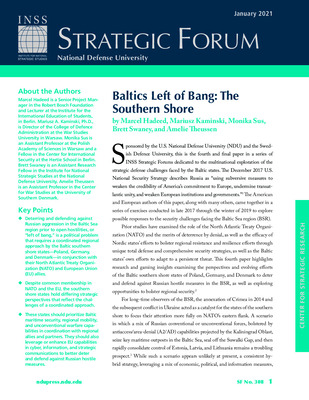
Baltics Left of Bang: The Southern Shore
Marcel Hadeed, Mariusz Kaminski, Monika Sus, Brett Swaney, and Amelie Theussen
Sponsored by the U.S. National Defense University (NDU) and the Swedish Defence University, this is the fourth and final paper in a series of INSS Strategic Forums dedicated to the multinational exploration of the strategic defense challenges faced by the Baltic states. The December 2017 U.S. National Security Strategy describes Russia as “using subversive measures to weaken the credibility of America’s commitment to Europe, undermine transatlantic unity, and weaken European institutions and governments.”1 The American and European authors of this paper, along with many others, came together in a series of exercises conducted in late 2017 through the winter of 2019 to explore possible responses to the security challenges facing the Baltic Sea region (BSR).
-
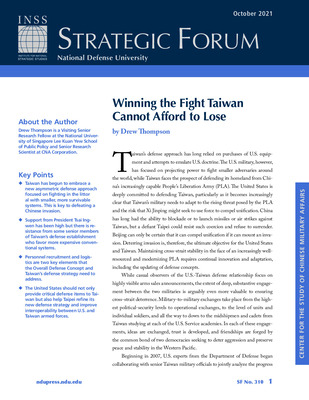
Winning the Fight Taiwan Cannot Afford to Lose
Drew Thompson
Taiwan’s defense approach has long relied on purchases of U.S. equipment and attempts to emulate U.S. doctrine. The U.S. military, however, has focused on projecting power to fight smaller adversaries around the world, while Taiwan faces the prospect of defending its homeland from China’s increasingly capable People’s Liberation Army (PLA). The United States is deeply committed to defending Taiwan, particularly as it becomes increasingly clear that Taiwan’s military needs to adapt to the rising threat posed by the PLA and the risk that Xi Jinping might seek to use force to compel unification. China has long had the ability to blockade or to launch missiles or air strikes against Taiwan, but a defiant Taipei could resist such coercion and refuse to surrender. Beijing can only be certain that it can compel unification if it can mount an invasion. Deterring invasion is, therefore, the ultimate objective for the United States and Taiwan. Maintaining cross-strait stability in the face of an increasingly wellresourced and modernizing PLA requires continual innovation and adaptation, including the updating of defense concepts.
-
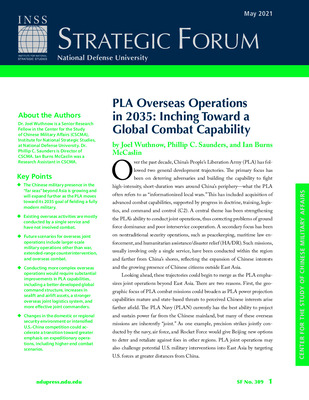
PLA Overseas Operations in 2035: Inching Toward a Global Combat Capability
Joel Wuthnow, Phillip C. Saunders, and Ian Burns McCaslin
Over the past decade, China’s People’s Liberation Army (PLA) has followed two general development trajectories. The primary focus has been on deterring adversaries and building the capability to fight high-intensity, short-duration wars around China’s periphery—what the PLA often refers to as “informationized local wars.” This has included acquisition of advanced combat capabilities, supported by progress in doctrine, training, logistics, and command and control (C2). A central theme has been strengthening the PLA’s ability to conduct joint operations, thus correcting problems of ground force dominance and poor interservice cooperation. A secondary focus has been on nontraditional security operations, such as peacekeeping, maritime law enforcement, and humanitarian assistance/disaster relief (HA/DR). Such missions, usually involving only a single service, have been conducted within the region and farther from China’s shores, reflecting the expansion of Chinese interests and the growing presence of Chinese citizens outside East Asia.
-
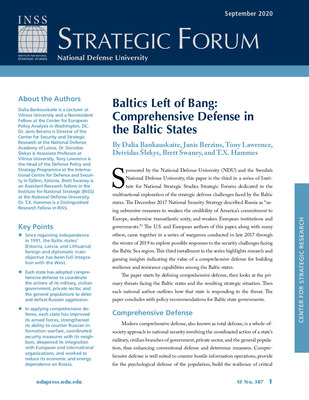
Baltics Left of Bang: Comprehensive Defense in the Baltic States
Dalia Bankauskaite, Janis Berzins, Deividas Slekys, Tony Lawrence, Brett Swaney, and T.X. Hammes
Sponsored by the National Defense University (NDU) and the Swedish National Defense University, this paper is the third in a series of Institute for National Strategic Studies Strategic Forums dedicated to the multinational exploration of the strategic defense challenges faced by the Baltic states. The December 2017 National Security Strategy described Russia as “using subversive measures to weaken the credibility of America’s commitment to Europe, undermine transatlantic unity, and weaken European institutions and governments.” The U.S. and European authors of this paper, along with many others, came together in a series of wargames conducted in late 2017 through the winter of 2019 to explore possible responses to the security challenges facing the Baltic Sea region. This third installment in the series highlights research and gaming insights indicating the value of a comprehensive defense for building resilience and resistance capabilities among the Baltic states.
-
The European Union’s Permanent Structured Cooperation: Implications for Transatlantic Security
Jonathan Dunn
In November of 2017, the European Union (EU) officially launched the Permanent Structured Cooperation (PESCO) project, its latest attempt to deepen defense cooperation among EU members. Earlier that same year, the EU approved two other important initiatives designed to strengthen defense cooperation: the Coordinated Annual Review on Defence (CARD) and the European Defence Fund (EDF). Shortly after the launch of PESCO, many U.S. defense officials expressed skepticism about its value.1 This is not surprising; U.S. officials have reflexively opposed European defense initiatives such as PESCO since the end of the Cold War. U.S. opposition to these initiatives reflects its fear that they could lead the EU to become a competitor to the North Atlantic Treaty Organization (NATO) for European security issues and resources, and in so doing reduce U.S. influence in European security.
-
Beyond Borders: PLA Command and Control of Overseas Operations
Dr. Phillip C. Saunders
China’s latest round of military reforms is driven primarily by Xi Jinping’s ambition to reshape the People’s Liberation Army (PLA) to improve its ability to win informationized [xinxihua, 信息化] wars and to ensure that it remains loyal to the Chinese Communist Party (CCP). The reforms are unprecedented in their ambition and in the scale and scope of the organizational changes. Virtually every part of the PLA now reports to different leaders, has had its mission and responsibilities changed, has lost or gained subordinate units, or has undergone a major internal reorganization. The relationships between and among the Central Military Commission (CMC) departments, offices, and commissions, the services, and the theater commands (TCs) have all changed. The reforms established new joint command and control mechanisms and thus have important implications for how the PLA conducts operations within and beyond China’s borders.
-
Baltics Left of Bang: Nordic Total Defense and Implications for the Baltic Sea Region
Håkon Lunde Saxi Ph.D., Bengt Sundelius, and Brett Swaney
Sponsored by the U.S. National Defense University (NDU) and the Swedish National Defense University, this paper is the second in a series of Institute for National Strategic Studies Strategic Forums dedicated to the multinational exploration of the strategic and defense challenges faced by the Baltic states. The December 2017 U.S. National Security Strategy described Russia as “using subversive measures to weaken the credibility of America’s commitment to Europe, undermine transatlantic unity, and weaken European institutions and governments.” The U.S. and European authors of this paper, along with many others, came together in late 2017 to explore possible responses to the security challenges facing the Baltic Sea Region (BSR). This second report highlights early research and gaming insights indicating the importance of total defense and comprehensive security, whole-of-society approaches to deterrence and defense of the Baltic Sea Region from Russian aggression. It also provides recommendations for how the Nordic and Baltic states can leverage aspects of total defense and comprehensive security to generate a credible asymmetric defense and build societal resilience.
-
Just Another Paper Tiger? Chinese Perspectives on the U.S. Indo-Pacific Strategy
Dr. Joel Wuthnow
In March 2018, Chinese foreign minister Wang Yi responded to a question about the Donald Trump administration’s new “free and open Indo-Pacific” strategy by comparing it to “sea foam in the Pacific or Indian Ocean” that might get some attention, “but soon will dissipate.” Wang’s remarks raise an important question for U.S. policymakers: Is Beijing so confident in its own influence, and doubtful of U.S. commitments in the region, that it perceives a green light to continue or expand the kinds of behavior Washington is trying to discourage, such as coercion of China’s territorial rivals and “predatory” lending?
-
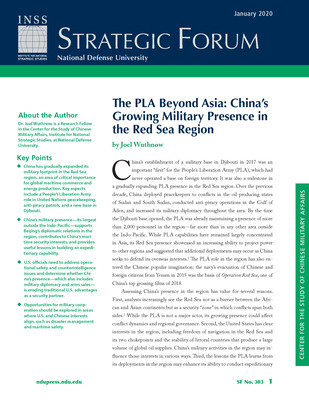
The PLA Beyond Asia: China’s Growing Military Presence in the Red Sea Region
Dr. Joel Wuthnow
China’s establishment of a military base in Djibouti in 2017 was an important “first” for the People’s Liberation Army (PLA), which had never operated a base on foreign territory. It was also a milestone in a gradually expanding PLA presence in the Red Sea region. Over the previous decade, China deployed peacekeepers to conflicts in the oil-producing states of Sudan and South Sudan, conducted anti-piracy operations in the Gulf of Aden, and increased its military diplomacy throughout the area. By the time the Djibouti base opened, the PLA was already maintaining a presence of more than 2,000 personnel in the region—far more than in any other area outside the Indo-Pacific. While PLA capabilities have remained largely concentrated in Asia, its Red Sea presence showcased an increasing ability to project power to other regions and suggested that additional deployments may occur as China seeks to defend its overseas interests.1 The PLA role in the region has also entered the Chinese popular imagination: the navy’s evacuation of Chinese and foreign citizens from Yemen in 2015 was the basis of Operation Red Sea, one of China’s top grossing films of 2018.
-
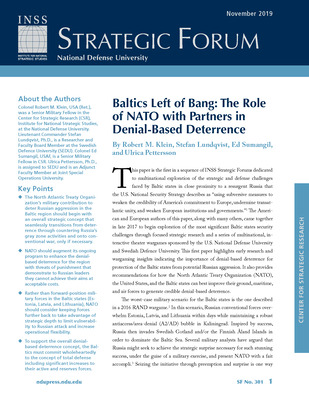
Baltics Left of Bang: The Role of NATO with Partners in Denial-Based Deterrence
Robert M. Klein, Stefan Lundqvist, Ed Sumangil USAF, and Ulrica Pettersson Ph.D.
This paper is the first in a sequence of INSS Strategic Forums dedicated to multinational exploration of the strategic and defense challenges faced by Baltic states in close proximity to a resurgent Russia that the U.S. National Security Strategy describes as “using subversive measures to weaken the credibility of America’s commitment to Europe, undermine transatlantic unity, and weaken European institutions and governments." The American and European authors of this paper, along with many others, came together in late 2017 to begin exploration of the most significant Baltic states security challenges through focused strategic research and a series of multinational, interactive theater wargames sponsored by the U.S. National Defense University and Swedish Defence University. This first paper highlights early research and wargaming insights indicating the importance of denial-based deterrence for protection of the Baltic states from potential Russian aggression. It also provides recommendations for how the North Atlantic Treaty Organization (NATO), the United States, and the Baltic states can best improve their ground, maritime, and air forces to generate credible denial-based deterrence.
-
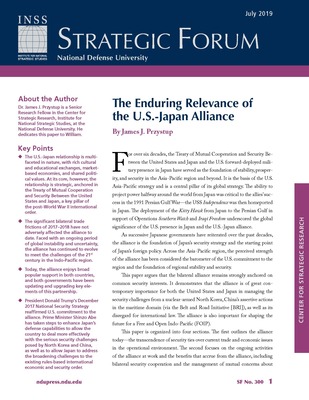
The Enduring Relevance of the U.S.-Japan Alliance
James J. Przystup
For over six decades, the Treaty of Mutual Cooperation and Security Between the United States and Japan and the U.S. forward-deployed military presence in Japan have served as the foundation of stability, prosperity, and security in the Asia-Pacific region and beyond. It is the basis of the U.S. Asia-Pacific strategy and is a central pillar of its global strategy. The ability to project power halfway around the world from Japan was critical to the allies’ success in the 1991 Persian Gulf War—the USS Independence was then homeported in Japan. The deployment of the Kitty Hawk from Japan to the Persian Gulf in support of Operations Southern Watch and Iraqi Freedom underscored the global significance of the U.S. presence in Japan and the U.S.-Japan alliance.
-
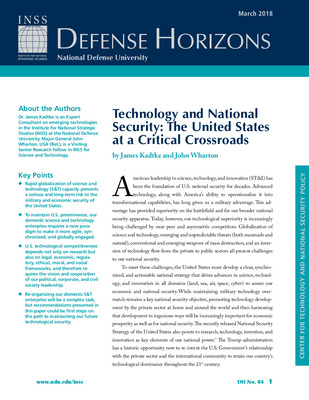
Technology and National Security: The United States at a Critical Crossroads
James Kadtke and John Wharton
The United States is at a turning point in how technology shapes national security. Rapid global advances in science and technology are eroding traditional U.S. advantages. Competitors are gaining ground, and innovation is no longer driven by governments alone. Maintaining leadership will require more than research funding. The authors call for a more agile and coordinated approach, one that connects government, industry, and academia. Technology policy must also account for economic, legal, and social factors that shape innovation and competitiveness. Without reform, the United States risks falling behind.
-
Low-Cost Access to Space: Military Opportunities and Challenges
Philip Stockdale, Scott Aughenbaugh, and Nickolas J. Boensch
Access to space has long been limited by high costs, but that is starting to change. Falling launch costs, driven largely by commercial innovation, could reshape U.S. military space operations. Today’s space systems rely on a small number of expensive, highly capable satellites. Lower-cost access could enable a shift toward more distributed, flexible architectures and this creates new opportunities. The military could deploy capabilities more quickly, expand missions, and improve resilience. However, this also introduces risks. As access to space becomes cheaper, more actors, including adversaries, can develop and deploy space and missile technologies. This paper argues that the United States must adapt its policies, acquisition models, and strategy to take advantage of these changes while managing emerging threats.
-
The Pentagon’s Pivot: How Lead Users Are Transforming Defense Product Development
Adam Jay Harrison
The Pentagon is rethinking how it develops military capabilities. Traditional defense acquisition, built on long-term forecasting and rigid requirements, is struggling to keep pace with rapid technological change. Instead, the Department of Defense is beginning to adopt a new approach centered on “lead users”: operators and practitioners who encounter problems early and develop solutions in real time. This shift moves innovation closer to the field. Rather than predicting future needs, the military can adapt faster by learning from those already solving emerging challenges. Lead user-driven development also aligns more closely with commercial innovation cycles, improving speed and relevance. To remain competitive, the Pentagon must continue evolving such as embracing more agile, user-informed models that better connect technology, operators, and mission needs.
-
Developing an Innovation- Based Ecosystem at the U.S. Department of Defense: Challenges and Opportunities
Adam Jay Harrison, Bharat Rao, and Bala Mulloth
The Department of Defense must move beyond traditional, centralized models of research and development. Instead, it should build an ecosystem that connects government, industry, and academia to accelerate innovation. This approach focuses on people as much as technology. Programs like the MD5 National Security Technology Accelerator highlight the importance of developing human capital, networks, and entrepreneurial skills to generate new solutions. An effective ecosystem would support dual-use technologies, strengthen collaboration, and improve the transition of ideas into real capabilities. To stay competitive, the Pentagon must foster a more flexible, connected, and continuously evolving innovation environment.
-
Will Technological Convergence Reverse Globalization?
T.X. Hammes
The Economist defines globalization as the “global integration of the movement of goods, capital and jobs,” and for decades, the process has been advancing. The combination of labor cost advantages, increasingly efficient freight systems, and trade agreements fueled globalization by providing regional cost advantages for manufacturing. Over the last six decades, it transformed agricultural societies into industrial powerhouses.
-
Korean Unification and the Future of the U.S.-ROK Alliance
David F. Helvey
Security alliances can take many forms. They can be bilateral or multilateral, symmetric or asymmetric, highly institutionalized or largely unstructured. Regardless of form, security alliances as instruments of statecraft, at their most fundamental level, reflect a deliberate commitment among states to aggregate resources in the pursuit of common interests. For over 60 years, the U.S.–Republic of Korea (ROK) alliance has defended South Korea from external attack and, through the combined efforts of both countries, contributed to peace and stability not only on the Korean Peninsula, but also in Northeast Asia, across the Asia-Pacific, and beyond.
-

Reflections on U.S.-Cuba Military-to-Military Contacts
Hal Klepak
The strategic import of U.S.-Cuba relations was underscored by President Barack Obama’s historic visit to Cuba from March 20–22, 2016, and his comment that he had come to Cuba “to bury the last remnant of the Cold War in the Americas.” Geography also reinforces the strategic importance of both countries to one another. Cuba sits astride the intersection of the three large bodies of water dominating the approaches to the southern United States. The large island nation is in a position to block, complicate, or facilitate U.S. border control efforts in many ways. Partnering with Cuba also might allow the United States to benefit from Cuba’s notable record of using soft power effectively in the Western Hemisphere and beyond.
-
Cross-Functional Teams in Defense Reform: Help or Hindrance?
Christopher J. Lamb
On May 12, 2016, the Senate Armed Services Committee (SASC) announced its markup of the National Defense Authorization Act (NDAA) for fiscal year 2017. Committee chairman John McCain (RAZ) stated that the bill “contains the most sweeping reforms of the organization of the Department of Defense [DOD] in a generation.” The House Armed Services Committee version of the NDAA contained fewer reforms, but the committee emphasized that reform was necessary because “security challenges have become more transregional, multi-domain, and multi-functional. . . . U.S. superiority in key warfighting areas is at risk with other nations’ technological advances; and . . . [DOD] lacks the agility and adaptability necessary to support timely decisionmaking and the rapid fielding of new capabilities.”
-
National Security Reform and the 2016 Election
Christopher J. Lamb and Joseph Bond
This paper assesses the persistent challenges of national security reform in the United States and evaluates whether reform might emerge as a salient issue in the 2016 Presidential election. Although calls for restructuring the U.S. national security system have circulated for decades — driven by critiques from blue-ribbon commissions, policymakers, and scholars — meaningful reform has remained largely unrealized. The authors trace the evolution of reform efforts from the post-Cold War era through the Obama administration, examining why early momentum dissipated despite widespread concern among defense and intelligence communities. They explore structural, institutional, and political barriers that have hindered change, analyze how reform narratives have been sidelined in electoral politics, and consider whether shifting threat perceptions and electoral dynamics could reposition national security reform as a viable campaign topic. The paper concludes by arguing that integrating reform into the broader national security debate would benefit both candidates and the nation by clarifying priorities, enhancing institutional agility, and better aligning strategic capabilities with evolving global challenges.
-
China’s Future SSBN Command and Control Structure
David C. Logan
China’s ongoing modernization program is transforming the country’s nuclear arsenal from one consisting of a few liquid-fueled, silo-based missiles carrying single warheads to a larger force of more advanced mobile solid-fueled missiles, some of which are capable of carrying multiple warheads. Perhaps most significant for its nuclear policies, China is also on the verge of fielding its first credible sea-based nuclear deterrent, having already completed four nuclear ballistic missile submarines (SSBNs) and with a fifth vessel currently under construction.