

-
Burma in Strategic Perspective: Renewing Discussion of Options
Lewis M. Stern, George Thomas, and Julia A. Thompson
U.S. policy has sought to nudge the junta in Burma toward a more reasonable approach to its dilemma, either in the form of managing Aung San Suu Kyi’s house arrest in a semitransparent fashion, allowing the release of imprisoned prodemocracy activists and the National League for Democracy cadre, agreeing to visits from United Nations special representatives, or accepting regional advice and guidance at critical moments. But Burma is a minuet dramatizing the “one step forward, two steps backward” description of progress. Even as the administration of President Barack Obama commits itself in principle to reaching out to Burma, events conspire against another effort to coax the junta toward a reasonable, regionally acceptable solution to its hard edge.
-
Irregular Warfare: New Challenges for Civil-Military Relations
Patrick M. Cronin
Success in the highly political and ambiguous conflicts likely to dominate the global security environment in the coming decades will require a framework that balances the relationships between civilian and military leaders and makes the most effective use of their different strengths. These challenges are expected to require better integrated, whole-of-government approaches, the cooperation of host governments and allies, and strategic patience.
-
China’s Rising Influence in Asia: Implications for U.S. Policy
Ellen L. Frost, James J. Przystup, and Phillip C. Saunders
The balance of power in East Asia is stable and favors the United States, but the balance of influence is tipping toward Beijing. China’s growing weight stems from its size and market dynamism, reinforced by newfound military restraint and skillful diplomacy that have enhanced its ability to translate power into influence. The shift in the balance of influence, if unaddressed, could undermine U.S. interests.
-
The Absence of Europe: Implications for International Security?
Steven Philip Kramer
Facing a worsening economic situation and a war in Iraq that will be difficult to end—in short, grave overstretch—the next U.S. adminis- tration will seek to return to a more multilateral foreign policy and attempt to work closely with Europe. But Europe may not be willing or able to meet American expectations to play a larger role in international security.
-
Energy Security in South Asia: Can Interdependence Breed Stability?
Joseph McMillan
South Asia is projected to play a major role in global energy markets over the next several decades, with India alone expected to become the world’s third largest importer of petroleum by 2030. Satisfying the region’s growing demands will require a heightened degree of energy interdependence among historically antagonistic states. Consequently, like it or not, regional leaders will face a tradeoff between traditional desires for energy self-sufficiency and the ambitious development targets that they have set for themselves. Achieving such growth, therefore, requires that India, Pakistan, and the other countries of South Asia first address the persistent international disputes that hamper cross-border energy trade, establish effective control over presently ungoverned areas, reorient the missions of military forces to some extent, and develop a better understanding of the effects that energy interdependence will have on broader relations with neighbors.
-
Defense Transformation à la française and U.S. Interests
Leo G. Michel
France has embarked on a transformation of its national security strategy, structures, capabilities, and relationships with Allies and other international partners. At its core, this transformation reflects a growing French consensus that globalization—especially the emergence of new, less predictable threats and vulnerabilities—has profoundly altered defense requirements since the last comprehensive review in the mid-1990s. But President Nicolas Sarkozy, faced with a large budget deficit, is determined to meet those requirements without near-term increases in defense spending.
-
NATO’s Uncertain Future: Is Demography Destiny?
Jeffrey Simon
The North Atlantic Treaty Organization (NATO) is no stranger to controversy. Over the past 60 years, it has endured disputes over defense strategy, the role of nuclear weapons, the size and composition of its membership, and how best to respond to looming challenges beyond its immediate territory. Today, however, the Atlantic Alliance finds itself increasingly stressed by emerging socioeconomic and political changes among the Allies—changes that are fundamentally influenced by larger demographic shifts now occurring within its membership and that, taken together, will almost certainly hamper its collective ability to deploy operational forces and further strain the transatlantic relationship in the years ahead. This paper offers a preliminary assessment of these trends, focusing specifically on the kinds of impacts that each is having, or will have, upon the Allies and the challenges for Alliance solidarity that may result.
-
Challenges to Persian Gulf Security: How Should the United States Respond?
Judith S. Yaphe
Persian Gulf security challenges will increasingly pose difficult choices for the next administration. Iran’s quest for regional preeminence, driven by the impulses of exceptionalism and self-sufficiency that are deeply engrained in the country’s political psyche, will not slacken any time soon. Seeing such preeminence as its historic prerogative, Tehran still aspires to acquire a military posture, including nuclear capability, commensurate with that vision.
-
The European Union: Measuring Counterterrorism Cooperation
David T. Armitage Jr.
The United States and European Union (EU) are natural partners in the global war on terror, but cooperation, although absolutely necessary, is inherently difficult. Primary responsibility for most European counterterrorism policies remains with the separate governments of the 27 EU countries, which has presented coordination problems both within the EU and between the United States and European Union. Asymmetries in capacities and perceived vulnerabilities affect how different member states address counterterrorism. Institutional dynamics—not only among the various EU institutions but also between the EU and the North Atlantic Treaty Organization (NATO)—influence the degree of cooperation as well.
-
Can Deterrence Be Tailored?
M. Elaine Bunn
Deterrence, the hallmark of Cold War–era security, needs to be adapted to fit the more volatile security environment of the 21st century. The Bush administration has outlined a concept for tailored deterrence to address the distinctive challenges posed by advanced military competitors, regional powers armed with weapons of mass destruction (WMD), and nonstate terrorist networks—while assuring allies and dissuading potential competitors.
-
Trans-American Security: What’s Missing?
Luigi R. Einaudi
The countries of the Western Hemisphere are more integrated than ever, with both each other and countries elsewhere, but critical aspects of their relationships remain hampered by outdated patterns and stereotypes. As the United States has focused on terrorism in the Middle East and Asia, its neighbors are developing more assertive roles on the world stage.
-
The Country Team: Restructuring America’s First Line of Engagement
Robert B. Oakley and Michael Casey
U.S. Embassies face unprecedented challenges. The kinds of issues that confound governments today—from organized crime, drug trafficking, and terrorism to nuclear proliferation, human rights, ethnosectarian conflict, global disease, and climate change—no longer fit within diplomacy’s traditional categories.1 Just as nonstate actors everywhere are becoming more powerful, regions of geostrategic importance in the developing world find themselves beset by weak or dysfunctional governments and increasingly perilous socioeconomic situations. While some might reasonably question the categorical quality of the 2002 National Security Strategy’s assertion that “America is now threatened less by conquering states than we are by failing ones,” there is still plenty of reason to be concerned about the trends.2
-
Preventing Balkan Conflict: The Role of Euroatlantic Institutions
Jeffrey Simon
Since the end of the Cold War, the Balkan region has presented major security challenges to the United States and Europe. The instability and weak governance of the region remain an important concern in the post-9/11 period. Balkan regional tensions erupted in several wars resulting from the disintegration of the former Yugoslavia in 1991. After a slow initial response from Europe and confronted by an inadequate United Nations (UN) effort in Bosnia-Herzegovina (BiH), the United States convinced the North Atlantic Treaty Organization (NATO) to initiate a decade-long peacekeeping mission to safeguard implementation of the Dayton Accords. Then, in an effort to halt a humanitarian catastrophe stemming from ethnic cleansing in Kosovo, NATO engaged in an air campaign against Serbia and another major peacekeeping operation in Kosovo.1
-
After the Surge: Next Steps in Iraq?
Judith S. Yaphe
The U.S. military “surge” initiated in mid-2007 in Baghdad and neighboring Iraqi provinces has been largely successful in military terms. It has helped to lower the level of violence suffered by Iraqis and Americans alike and, in tandem with other steps, has restored a measure of security to western Iraq and portions of Baghdad. Yet military operations alone are insufficient to restore stability and keep the country intact.
-
Combating Opium in Afghanistan
Ali A. Jalali, Robert B. Oakley, and Zoe Hunter
Opium continues to pose one of the most serious threats to stability and good governance in Afghanistan. Proceeds and protection fees from trafficking are funneled to terrorist and insurgent groups, including the Taliban and al Qaeda. Insurgents have successfully leveraged poppy eradication efforts to increase popular resistance to both the government in Kabul and the presence of coalition forces. Despite major increases in counternarcotics programs and resources over the past year, production has shot up 59 percent.
-
Reforming Pentagon Strategic Decisionmaking
Christopher J. Lamb and Irving Lachow
This Strategic Forum analyzes the institutional challenges facing strategic decisionmaking within the U.S. Department of Defense and proposes reforms to improve how senior leaders make and support decisions. It highlights how existing processes — designed to be rational and methodical — are often undermined by bureaucratic stovepipes, consensus-oriented products, and limited integration of analytic support. The paper argues for the creation of a dedicated Decision Support Cell reporting directly to the Secretary of Defense to provide integrated rational analyses and to enhance intuitive decisionmaking through exercises and shared experience. By clarifying baseline assumptions, improving cross-bureaucratic collaboration, and balancing rational and intuitive elements, the proposed reforms aim to elevate the quality and coherence of strategic choices in peace and war. Effective decision support is framed as essential to aligning strategic agenda, planning, and resource allocation across the Pentagon.
-
Southeast Asian Security Challenges: America’s Response?
Marvin C. Ott
The security situation in Southeast Asia is remarkably complex, with multiple forces and trends emanating from within the region and impacting it from without. The forces at work fall into two broad categories. One involves globalized, transnational, and multinational factors, such as rapid economic change with profound implications for political stability; the sudden emergence of militant jihadist networks that have mounted violent attacks against the political and cultural status quo in much of the region; and transnational environmental and health issues typified by the Severe Acute Respiratory Syndrome (SARS) epidemic and current concerns regarding avian flu. Second, the dramatic growth in Chinese power (economic, military, and diplomatic) confronts the region with a situation familiar to traditional geopolitics. Both Chinese policy and some regional responses (notably those of Singapore) reflect a sophisticated understanding of the nuances of classic realpolitik.
-
Visions of Order: Japan and China in U.S. Strategy
James J. Przystup and Phillip C. Saunders
The search for order has long challenged diplomats and statesmen. Today’s liberal international economic and political order has evolved out of a century of conflict, revolution, and war into a pattern of interest-based cooperation among the world’s great powers. The international system, however, is not a self-regulating mechanism; maintenance of order, once established, requires the active and full participation of major powers with high stakes in the effective functioning of the system.
-
China, Russia and the Balance of Power in Central Asia
Eugene B. Rumer
Since the Shanghai Cooperation Organization (SCO) called upon the United States to commit to withdraw its military personnel from Central Asia at its July 2005 summit, the SCO has acquired the reputation as a significant obstacle to U.S. policy. However, this reputation obscures the real state of affairs. Notwithstanding press reports about the challenge posed by the SCO to U.S. policy in Central Asia, a close look at the organization, the behavior of its members, their motivations, and the practical impact of their declarations suggests that the SCO’s challenge to U.S. interests and policies in Central Asia is less than meets the eye.
-
Restructuring Special Operations Forces for Emerging Threats
David Tucker and Christopher J. Lamb
Special Operations Forces (SOF) are vital for combating terrorism and the proliferation of weapons of mass destruction. SOF prominence in these missions has only grown since September 11, 2001, when the Nation realized its unprecedented power did not shield it from devastating unconventional attacks. While SOF are consumed by their operations in the war on terror, national leaders need to acknowledge neither Washington nor U.S. Special Operations Command (USSOCOM) is organized for optimal use of SOF.
-
Constabulary Forces and Postconflict Transition: The Euro-Atlantic Dimension
David T. Armitage Jr. and Anne M. Moisan
Since the early 1990s, multinational stabilization efforts in the wake of conflicts or major natural disasters have repeatedly encountered problems in filling the so-called security gap. In places such as Bosnia, Kosovo, Haiti, Afghanistan, Iraq, and elsewhere, outside interveners have faced a compelling need to use specialized capabilities that can fill the gap between the point where military operations—whether for combat, peacekeeping, or counterinsurgency—leave off and community-based policing activities pick up. In particular, ensuring a capacity to manage and defuse civil disturbances and other threats to public order has become a sine qua non for overall mission success.1
-
U.S.-Australia Alliance Relations: An Australian View
Paul Dibb
Australia is America’s oldest friend and ally in the Asia-Pacific region. The two countries fought alongside each other in World War I, World War II, Korea, Vietnam, the 1991 Gulf War, and most recently in Afghanistan and Iraq. The closeness of the two nations today is without precedent in the history of the relationship. Australia is now America’s second closest ally in the world, after the United Kingdom.
-
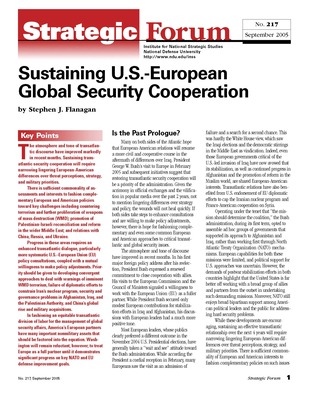
Sustaining U.S.-European Global Security Cooperation
Stephen J. Flanagan
Many on both sides of the Atlantic hope that European-American relations will resume a more civil and cooperative course in the aftermath of differences over Iraq. President George W. Bush’s visit to Europe in February 2005 and subsequent initiatives suggest that restoring transatlantic security cooperation will be a priority of the administration. Given the acrimony in official exchanges and the vilification in popular media over the past 2 years, not to mention lingering differences over strategy and policy, the wounds will not heal quickly. If both sides take steps to enhance consultations and are willing to make policy adjustments, however, there is hope for fashioning complementary and even some common European and American approaches to critical transatlantic and global security issues.
-
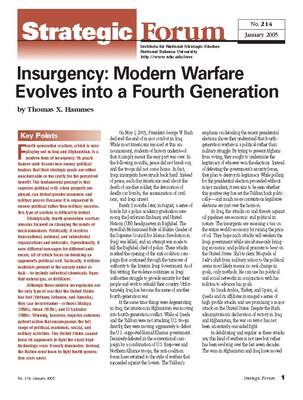
Insurgency: Modern Warfare Evolves into a Fourth Generation
T.X. Hammes
On May 1, 2003, President George W. Bush declared the end of major combat in Iraq. While most Americans rejoiced at this announcement, students of history understood that it simply meant the easy part was over. In the following months, peace did not break out, and the troops did not come home. In fact, Iraqi insurgents have struck back hard. Instead of peace, each day Americans read about the death of another soldier, the detonation of deadly car bombs, the assassination of civilians, and Iraqi unrest.
-
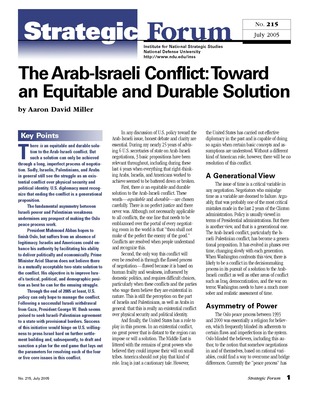
The Arab-Israeli Conflict: Toward an Equitable and Durable Solution
Aaron David Miller
In any discussion of U.S. policy toward the Arab-Israeli issue, honest debate and clarity are essential. During my nearly 25 years of advising 6 U.S. secretaries of state on Arab-Israeli negotiations, 3 basic propositions have been relevant throughout, including during these last 4 years when everything that right-thinking Arabs, Israelis, and Americans worked to achieve seemed to be battered down or broken.
The INSS Strategic Forum series presents original research by members of NDU as well as other scholars and specialists in national security affairs from the United States and abroad. The opinions, conclusions, and recommendations expressed or implied within are those of the contributors and do not necessarily reflect the views of the Defense Department or any other agency of the Federal Government.
Printing is not supported at the primary Gallery Thumbnail page. Please first navigate to a specific Image before printing.