

-
Deterrence and Escalation in Cross-domain Operations: Where Do Space and Cyberspace Fit?
Vincent Manzo
Warfare has become even more complicated since Richard Smoke wrote this description of escalation in 1977. The National Security Space Strategy describes space as “congested, contested, and competitive,” yet satellites underpin U.S. military and economic power. Activity in cyberspace has permeated every facet of human activity, including U.S. military operations, yet the prospects for effective cyber defenses are bleak. Many other actors depend on continued access to these domains, but not nearly as much as the United States.
-
Finland, Sweden, and NATO: From “Virtual” to Formal Allies?
Leo G. Michel
The “Open Door” policy of the North Atlantic Treaty Organization (NATO) has been an article of faith for Allies and aspirants alike for more than a decade. Its most recent formulation, approved at the November 2010 Lisbon Summit, states: “The door to NATO membership remains fully open to all European democracies which share the values of our Alliance, which are willing and able to assume the responsibilities and obligations of membership, and whose inclusion can contribute to common security and stability.”
-
Chinese Military Transparency: Evaluating the 2010 Defense White Paper
Phillip C. Saunders and Ross Rustici
The People’s Republic of China (PRC) State Council Information Office released the seventh edition of its biennial defense white paper, “China’s National Defense in 2010,” on March 31, 2011. This document aims to communicate the latest information on China’s military development, strategy, capabilities, and intentions. China began publishing defense white papers in 1998, partly as a means of increasing transparency in response to regional concerns about the growing capabilities and actions of the People’s Liberation Army (PLA). Despite the systematic release of these documents, many of China’s neighbors and other regional powers continue to express concerns about China’s lack of military transparency. The Chinese maintain that they are becoming more open over time and highlight the importance of transparency about strategic intentions rather than capabilities.
-
Avoiding a Crisis of Confidence in the U.S. Nuclear Deterrent
John P. Caves Jr.
The United States needs to modernize and ensure the long-term reliability and responsiveness of its aging nuclear deterrent force and nuclear weapons infrastructure. It cannot otherwise safely reduce its nuclear weapons, responsibly ratify the Comprehensive Test Ban Treaty, confidently deter and contain challenges from rising or resurgent nuclear-armed near peers, and effectively dissuade allies and partners from acquiring their own nuclear weapons. Modernization is fundamental to avoiding a future crisis of confidence in the U.S. nuclear deterrent.
-
Reforming the Inter-American Defense Board
John A. Cope
Does the Inter-American Defense Board (IADB) have a future in an era of multidimensional security? Burdened by a mid-20th-century military structure and a tradition of U.S. leadership, lingering deep antimilitary discomfort within the Organization of American States (OAS), and severely shrinking financial and human resources, the Board, with its secretariat and 27-member council of delegates,1 has not been functionally useful to the OAS or its own membership and is ripe for disestablishment. Perceived to be out of touch, inflexible, and difficult to control, the IADB would cease to exist if funding were denied or markedly reduced.2
-
Private Contractors in Conflict Zones: The Good, the Bad, and the Strategic Impact
T.X. Hammes
In Iraq and Afghanistan, the use of contractors reached a level unprecedented in U.S. military operations. As of March 31, 2010, the United States deployed 175,000 troops and 207,000 contractors in the war zones. Contractors represented 50 percent of the Department of Defense (DOD) workforce in Iraq and 59 percent in Afghanistan. These numbers include both armed and unarmed contractors. Thus, for the purposes of this paper, the term contractor includes both armed and unarmed personnel unless otherwise specified. The presence of contractors on the battlefield is obviously not a new phenomenon but has dramatically increased from the ratio of 1 contractor to 55 military personnel in Vietnam to 1:1 in the Iraq and 1.43:1 in Afghanistan.
-
Africa’s Irregular Security Threats: Challenges for U.S. Engagement
Andre Le Sage
This paper provides an overview of Africa’s irregular, nonstate threats, followed by an analysis of their strategic implications for regional peace and stability, as well as the national security interests of the United States. After reviewing the elements of the emerging international consensus on how best to address these threats, the conclusion highlights a number of new and innovative tools that can be used to build political will on the continent to confront these security challenges. This paper is intended as a background analysis for those who are new to the African continent, as well as a source of detailed information on emerging threats that receive too little public or policy-level attention.
-
Somalia’s Endless Transition: Breaking the Deadlock
Andre Le Sage
Somalia’s Transitional Federal Government (TFG) was given a second lease on life in January 2009, after successful peace negotiations in Djibouti produced new Transitional Federal Government (TFG) leadership and yielded substantial international backing. However, the TFG remains weak and has yet to develop new political alliances or military capabilities that provide traction against Islamist insurgent groups. The insurgents themselves—including al Shabab and Hizbul Islamia—are also weak and internally divided.
-
Prioritizing Strategic Interests in South Asia
Robert B. Oakley and T.X. Hammes
The focus on the war in Afghanistan has prevented the United States from developing a South Asia strategy rooted in the relative strategic importance of the nations in the region. India, a stable democracy enjoying rapid growth, clearly has the most potential as a strategic partner. Pakistan, as the home of al Qaeda leadership and over 60 nuclear weapons, is the greatest threat to regional stability and growth. Yet Afghanistan absorbs the vast majority of U.S. effort in the region. The United States needs to develop a genuine regional strategy. This paper argues that making the economic growth and so- cial reform essential to the stability of Pakistan a higher priority than the conflict in Afghanistan is a core requirement of such a strategy.
-
Global Commons and Domain Interrelationships: Time for a New Conceptual Framework?
Mark E. Redden and Michael P. Hughes
This Strategic Forum argues that U.S. national security strategy must evolve to address challenges across the global commons — including the sea, air, space, and cyber domains — which are increasingly contested by state and non-state actors. The authors propose a new conceptual framework for understanding domain interrelationships and how operations in one domain can affect access and security in others. By emphasizing assured access and cross-domain integration, the paper outlines strategic and policy implications for defense planning, operational readiness, and long-term deterrence in an interconnected global threat environment.
-
U.S.-Mexico Homeland Defense: A Compatible Interface
Victor E. Renuart Jr. and Biff Baker
This paper responds to a previous Strategic Forum (no. 243, July 2009) entitled U.S.-Mexico Defense Relations: An Incompatible Interface by Craig Deare. Some of the assertions and conclusions within Dr. Deare’s paper were flawed due to an outdated U.S.-Mexico paradigm that preceded the 9/11 attacks and recent counter-drug operations in Mexico. If his work had been published prior to the establishment of U.S. Northern Command (USNORTHCOM), it would have been well received, but times have changed. Because of our collective experiences over the past 6 years, we find implausible the notion that USNORTHCOM is not staffed or experienced enough to support Mexico’s security cooperation needs. Hence, U.S.-Mexico Homeland Defense: A Compatible Interface is intended to set the record straight by pointing out the numerous areas of cooperation between Mexico and the United States since the establishment of USNORTHCOM.
-
Strengthening the IAEA: How the Nuclear Watchdog Can Regain Its Bark
Gregory L. Schulte
Yukiya Amano recently became the new Director General of the International Atomic Energy Agency (IAEA), the world’s nuclear watchdog. Amano, an experienced Japanese diplomat, faces a challenging agenda: stalled investigations into the clandestine nuclear activities of Iran and Syria, the need to ensure high levels of safety and security as more countries opt for nuclear power, the dangers associated with the spread of technologies readily diverted to build nuclear bombs, a threat of nuclear terrorism not taken seriously by all IAEA members, and a Board of Governors too often split between developed and developing countries.
-
Iraqi Security Forces after U.S. Troop Withdrawal: An Iraqi Perspective
Najim Abed Al-Jabouri
As U.S. Armed Forces draw down in Iraq, there is increasing concern about the possibility of resurgent ethnic and sectarian tensions. Many Iraqis believe that the United States may be making a grave mistake by not fully using its remaining leverage to insulate the Iraqi Security Forces (ISF) from the politi- cal influence of the incumbent Iraqi sectarian political parties. U.S. efforts to rebuild the ISF have focused on much needed training and equipment, but have neglected the greatest challenge facing the forces’ ability to maintain security upon U.S. withdrawal: an ISF politi- cized by ethno-sectarian parties. These ties pose the largest obstacle to the ISF in its quest to become genuinely professional and truly national in character.
-
Aligning Disarmament to Nuclear Dangers: Off to a Hasty START?
David A. Cooper
Confronted by a daunting array of nuclear threats, and having pledged to reinvigorate the application of disarmament tools to address these dangers, the Obama administration has decided to focus its initial efforts on negotiating a new bilateral agreement with Russia to replace the Cold War–era Strategic Arms Reduction Treaty (START), which expires at the end of this year.
-
U.S.-Mexico Defense Relations: An Incompatible Interface
Craig A. Deare
The United States and Mexico share a history that was shaped in the 19th century by numerous interventions by U.S. forces into Mexican territory and U.S. expropriation of considerable Mexican land. Although largely forgotten on the northern side of the border, this history has left a scar on the collective national psyche of Mexico, most notably on the military forces.
-
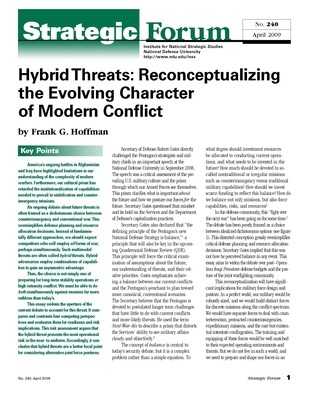
Hybrid Threats: Reconceptualizing the Evolving Character of Modern Conflict
Frank Hoffman
America’s ongoing battles in Afghanistan and Iraq have highlighted limitations in our understanding of the complexity of modern warfare. Furthermore, our cultural prism has retarded the institutionalization of capabilities needed to prevail in stabilization and counter-insurgency missions.
-
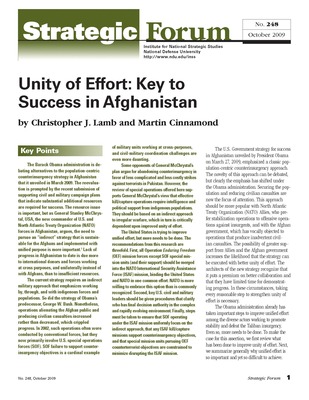
Unity of Effort: Key to Success in Afghanistan
Christopher J. Lamb and Martin Cinnamond
The Barack Obama administration is debating alternatives to the population-centric counterinsurgency strategy in Afghanistan that it unveiled in March 2009. The reevalua- tion is prompted by the recent submission of supporting civil and military campaign plans that indicate substantial additional resources are required for success. The resource issue is important, but as General Stanley McChrys- tal, USA, the new commander of U.S. and North Atlantic Treaty Organization (NATO) forces in Afghanistan, argues, the need to pursue an “indirect” strategy that is sustain- able for the Afghans and implemented with unified purpose is more important.1 Lack of progress in Afghanistan to date is due more to international donors and forces working at cross purposes, and unilaterally instead of with Afghans, than to insufficient resources.
-
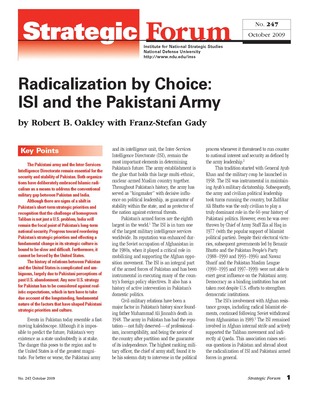
Radicalization by Choice: ISI and the Pakistani Army
Robert B. Oakley and Franz-Stefan Gady
The Pakistani army and the Inter-Services Intelligence Directorate remain essential for the security and stability of Pakistan. Both organizations have deliberately embraced Islamic radicalism as a means to address the conventional military gap between Pakistan and India.
-
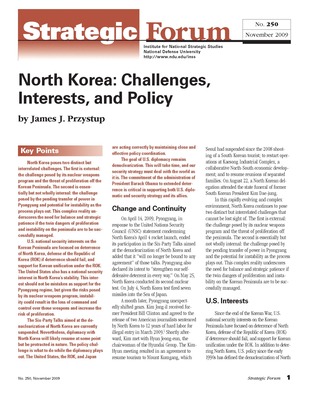
North Korea: Challenges, Interests, and Policy
James J. Przystup
North Korea poses two distinct but interrelated challenges. The first is external: the challenge posed by its nuclear weapons program and the threat of proliferation off the Korean Peninsula. The second is essentially but not wholly internal: the challenge posed by the pending transfer of power in Pyongyang and potential for instability as the process plays out. This complex reality underscores the need for balance and strategic patience if the twin dangers of proliferation and instability on the peninsula are to be successfully managed.
-
The United States and the Asia-Pacific Region: National Interests and Strategic Imperatives
James J. Przystup
Notwithstanding the 2008–2009 financial crisis, East Asia today remains the home of the world’s most dynamic economies. In 1990, the region’s share of global gross domestic prod- uct (GDP) amounted to 26.5 percent; in 2006, that figure stood at 37.5 percent. In 2006, the GDP growth rate for Asia’s economies aver- aged 5.1 percent, compared to a world average of 3.9 percent.
-
Managing Strategic Competition with China
Phillip C. Saunders
Officials in the Obama administration have highlighted the need for a “positive, cooperative, and comprehensive relationship” with China that can help the United States address an array of global challenges. Administration officials have not adopted the “responsible stakeholder” language that characterized recent U.S. China policy, but their overall approach appears compatible with that concept. Initial policy statements have focused on expanding U.S.-China cooperation, with particular emphasis on addressing the global economic crisis and climate change.
-
Ukraine Against Herself: To Be Euro-Atlantic, Eurasian, or Neutral?
Jeffrey Simon
Since independence, Ukrainians have been evenly split between those who desire to be part of the Euro-Atlantic (European Union and North Atlantic Treaty Organization) community and those who gravitate toward Eurasia (Russia and the Commonwealth of Independent States). During the 1990s, when the European Union and NATO were focused on Central Europe and Russia was politically down and economically weak, Ukraine was able to have it both ways.
-
Diverging Roads: 21st-century U.S.-Thai Defense Relations
Lewis M. Stern
The 175th anniversary of the signing of the Treaty of Amity and Commerce in 2008 was seized by both Thailand and the United States as a reason for celebrating a long and mutually beneficial treaty alliance. This alliance has been defined by the shared though not uncomplicated commitment to democracy and human rights, and the common interest in free and fair trade, all of which inform the tradition of bilateral cooperation.
-
U.S.-Cambodia Defense Relations: Defining New Possibilities
Lewis M. Stern
Cambodia’s lax border controls, widespread corruption, extremely active arms trade, and surfeit of small arms remaining from the Third Indochina War have made Phnom Penh an attractive platform for transient interests, as well as a staging ground for numerous activities that challenge the safety and well-being of the region.
-
U.S.-Vietnam Defense Relations: Deepening Ties, Adding Relevance
Lewis M. Stern
Normal defense relations between the United States and Vietnam emerged from discussions conducted from mid-1995 to late 1996. The first years of interaction between the American and Vietnamese defense establishments revolved around learning about one another, developing a common language, becoming accustomed to the differences in how the respective ministries managed policy and exercised authority, and learning to work with the personalities on both sides who were the mainstay of the relationship. At the outset, the Vietnamese were suspicious, conservative, and not inclined to move beyond argument about the “legacy issues,” such as the effects of Agent Orange and alleged U.S. Government support to antiregime organizations.
The INSS Strategic Forum series presents original research by members of NDU as well as other scholars and specialists in national security affairs from the United States and abroad. The opinions, conclusions, and recommendations expressed or implied within are those of the contributors and do not necessarily reflect the views of the Defense Department or any other agency of the Federal Government.
Printing is not supported at the primary Gallery Thumbnail page. Please first navigate to a specific Image before printing.