
-

PRISM Vol. 10, No. 4
Center for Complex Operations
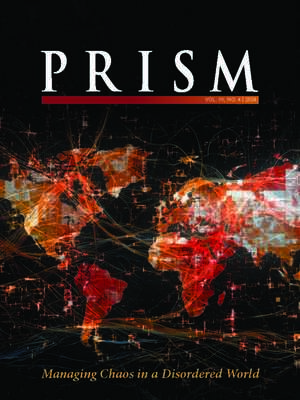
PRISM Vol. 10, No. 4 examines contemporary challenges in strategy, security, and international competition. The issue explores managing geopolitical disorder, U.S.-China soft power competition in Africa, strategic breakthrough and post-conflict planning, political sabotage, cybersecurity, space strategy, the global economic effects of the Russia-Ukraine conflict, and the role of special operations forces in integrated deterrence. Together, the contributions assess how states and security institutions can respond to an increasingly complex and contested strategic environment.
-

PRISM Vol. 10, No. 2
Center for Complex Operations
This issue of PRISM—titled “Forward Defense”—examines the security transformations taking place in these diverse but aligned countries. As distinct as these nine countries are they are each reinforcing, or in some cases rebuilding, their armed forces and reviving the Total Defense or Comprehensive Defense concepts they embraced during the Cold War. Total or Comprehensive Defense is a strategic approach that recognizes the multidimensional threat posed by autocratic countries and the existential threat to the liberal, rules-based world order. It understands that effective deterrence depends on both resistance and resilience and codes those into the respective security and defense strategies.
-
PRISM Vol. 10, No. 3
Center for Complex Operations
PRISM Vol. 10, No. 3 examines contemporary national and international security challenges, including defense innovation, the strategic use of intelligence, Russia’s war against Ukraine, European neutrality, and NATO security in the Baltic region. The issue also explores critical mineral supply chains, organized crime as a form of irregular warfare, and approaches to national resilience and collective defense. Together, the contributions assess how geopolitical competition, economic vulnerabilities, and evolving security threats are shaping defense policy and strategy.
-

PRISM-19
Center for Complex Operations
This special issue of PRISM is about the different perceptions and reactions to COVID-19 as people and governments experienced the disease, and their diverse understanding of its implications for national and international security.
-

PRISM Vol. 10, No. 1
Center for Complex Operations
PRISM Vol. 10, No. 1 is about great power competition and the changing global security environment, with particular attention to China’s growing military, economic, and political influence. The issue explores U.S.-China military rivalry, the Belt and Road Initiative and Eurasian competition, Chinese soft power, the employment of military power, the future global order, Russia’s war against Ukraine, and the demands of future military leadership. The contributions assess how shifting power dynamics are shaping military strategy, international competition, and national security.
-

PRISM Vol. 9, No. 2
Center for Complex Operations
The global COVID-19 pandemic of 2020-2021 has catalyzed a re-examination of what national security consists of, and what responsibilities the world’s armed forces must or should assume to meet such non-military challenges. Yet the competition between the United States and its adversaries has intensified, requiring that the national security enterprise retain traditional capabilities while keeping up with the fierce pace of technological innovation. PRISM V.9,N.2 authors address the emerging challenges armed forces must meet, offer perspectives on competitors, and suggest major changes in the innovation ecosystem.
-

PRISM Vol. 9, No. 3
Center for Complex Operations
PRISM Vol. 9, No. 3 focuses on how strategic competition, emerging technologies, and gray zone conflict are reshaping defense and national security. Articles address Russian strategic behavior, China’s artificial intelligence ambitions and military modernization, financial and technological competition between the United States and China, artificial intelligence and future warfare, gray zone aggression, Sweden’s total defense model, ethical governance of defense AI, and the electromagnetic spectrum as an operational domain. The issue highlights the growing importance of technological advantage, economic statecraft, resilience, and new forms of competition below the threshold of armed conflict.
-
PRISM Vol. 8, No. 3
Center for Complex Operations
Emerging disruptive technologies, including artificial intelligence, machine learning, quantum computing, and neuroscience will dramatically alter the global security environment. PRISM Vol. 8, No. 3 “Singularity” maps this evolving challenge and propose solutions.
-
PRISM Vol. 8, No. 4
Center for Complex Operations
As the National Security and National Defense Strategies state, the world has entered a phase of great power competition in which the United States is confronted by a rising China and a resurgent Russia. PRISM V.8,N.4 offers perspective on this competition with articles by Sir Lawrence Freedman, the Honorable Joseph Nye, and the Honorable Andrew Natsios.
-

PRISM Vol. 9, No. 1
Center for Complex Operations
Though Great Power Competition (or GPC) dominates the current national security discourse, the United States is a global power with global interests. In addition to GPC, PRISM V.9,N.1 offers insight on the future of NATO, on U.S. engagement in Africa, and on emerging technology domains of competition such as quantum computing, 5G technology, and influence operations. Read American and South East Asian perspectives on competition with China, as well as Huawei’s rejoinder to "The Worst Possible Day: U.S. Telecommunications and Huawei," from PRISM V.8,N.3.
-
PRISM Vol. 8, No. 1
Center for Complex Operations
PRISM Vol. 8, No. 1 centers on security and political change across the Western Hemisphere, particularly Latin America and the Caribbean. Articles address democratic governance and human rights, U.S. strategic engagement in the region, Venezuela’s political crisis, security challenges in Mexico and Colombia, and the growth of transnational criminal organizations in Brazil and across Latin America. The issue looks at how governance challenges, transnational crime, regional instability, and growing external influence are shaping security across the Western Hermisphere.
-

PRISM Vol. 8, No. 2
Center for Complex Operations
PRISM Vol. 8, No. 2 addresses a wide range of contemporary security challenges, from terrorism and lessons from the wars in Iraq and Afghanistan to hybrid warfare, Russian strategic behavior, and Iran’s regional activities. Articles also consider the implications of artificial intelligence, autonomous systems, and robotics for warfare and deterrence, Sweden’s revival of Total Defense, and comparative approaches to diplomatic security. The issue reflects the growing complexity of conflict as states and security institutions confront conventional, irregular, technological, and political challenges across multiple regions.
-
PRISM Vol. 7, No. 3
Center for Complex Operations
PRISM Vol. 7, No. 3 focuses on the evolving threat posed by weapons of mass destruction and the policies, capabilities, and institutions needed to counter them. Articles address nuclear and WMD terrorism, gaps in U.S. counter-WMD strategy, CBRN forensics, North Korea’s chemical and biological weapons capabilities, and the challenges of coordinating whole-of-government responses. The issue also considers counterterrorism operations in Iraq and the growing importance of gray zone conflict.
-

PRISM Vol. 7, No. 4
Center for Complex Operations
With this edition, PRISM completes our seventh volume and prepares to move toward full peer review status next year. The edition is non-themed but offers several features that highlight the importance of innovation and non-kinetic warfare. Among the distinguished authors are a former Supreme Allied Commander Transformation, the Director of Strategic Operational Planning at the National Counterterrorism Center, and a senior executive with the U.S. Department of Treasury. The edition also features a senior executive with the National Geospatial-Intelligence Agency, who is distinguished alumnus from NDU's Dwight D. Eisenhower School for National Security and Resource Strategy, as well as several military alum from NDU's Joint and combined Warfighting School.
-
PRISM Syria Supplemental
Center for Complex Operations
This issue provides an in-depth analysis of the ongoing Syrian conflict. Through a collection of expert essays, policy recommendations, and interviews, the issue explores the humanitarian crisis, the role of Salafi networks, and the socio-economic impact on Syria’s urban poor. Contributors offer insights on supporting the opposition, advancing transitional justice, and addressing the challenges of post-conflict reconciliation. Featuring perspectives from diplomats, scholars, and field practitioners, this volume serves as a guide for policymakers navigating the Syrian crisis.
-
PRISM Vol. 4, No. 4
Center for Complex Operations
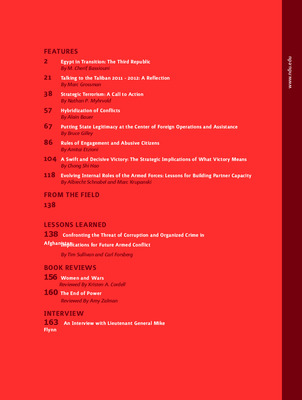
This volume explores critical global security issues and evolving geopolitical dynamics. It opens with an analysis of Egypt’s political transformation and a reflection on U.S.-Taliban negotiations. Other features address the rising threat of strategic terrorism, the hybrid nature of modern conflicts, and the importance of state legitimacy in foreign operations. Discussions on rules of engagement, the meaning of victory, and the shifting roles of armed forces provide further insight into contemporary military challenges. The "From the Field" section examines corruption and organized crime in Afghanistan. The volume concludes with book reviews on global power shifts and gender in warfare, and an interview with Lieutenant General Mike Flynn.
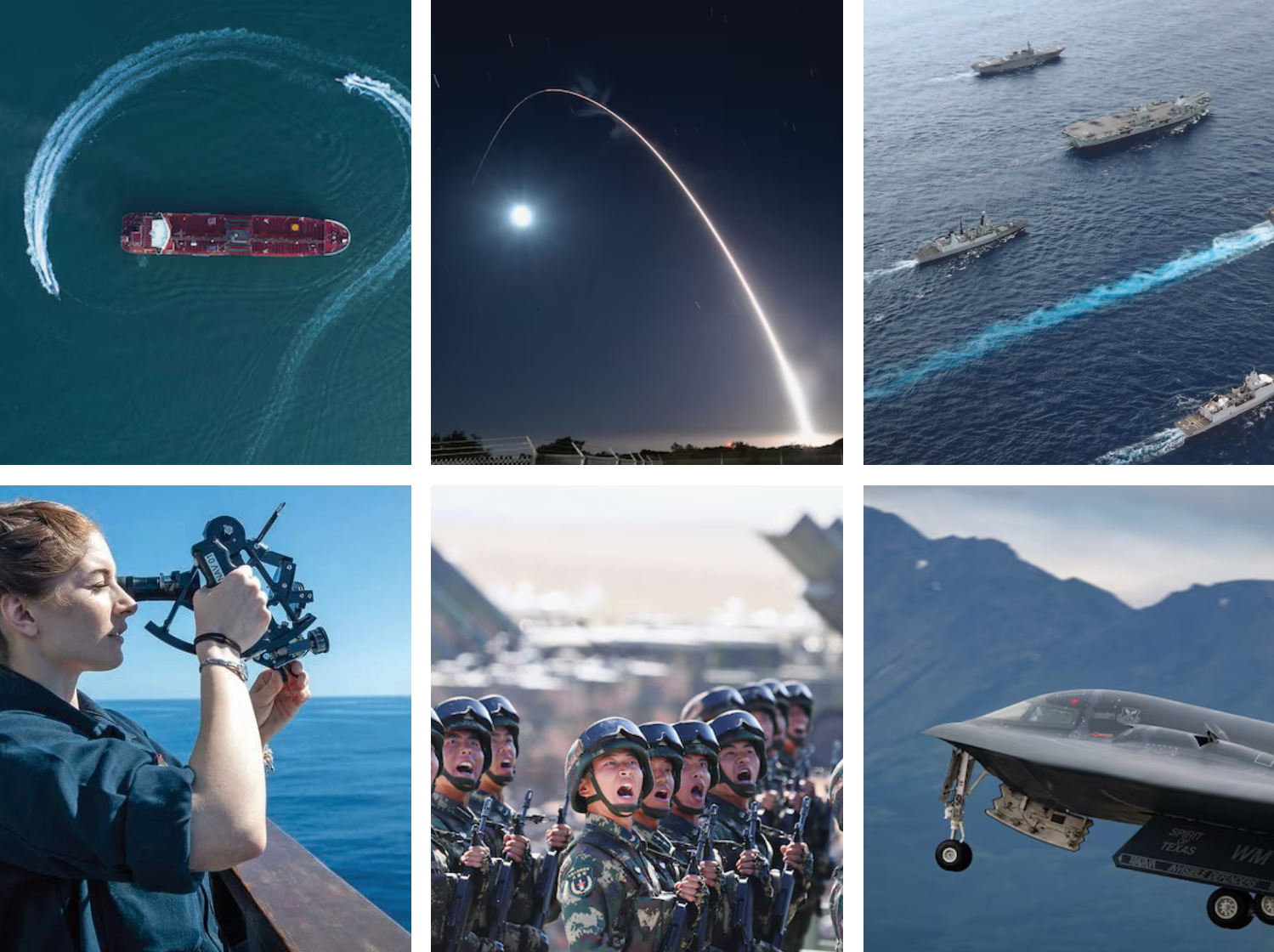
PRISM was National Defense University’s (NDU) flagship journal of national and international security affairs. PRISM’s mission is “To provide unique insight for current and future national security leaders on emerging security challenges beyond the strictly military domain of the joint force, including transnational, multi-domain threats, gray zone conflict, the technological innovation challenge, and geoeconomic competition among the great powers.”
Printing is not supported at the primary Gallery Thumbnail page. Please first navigate to a specific Image before printing.